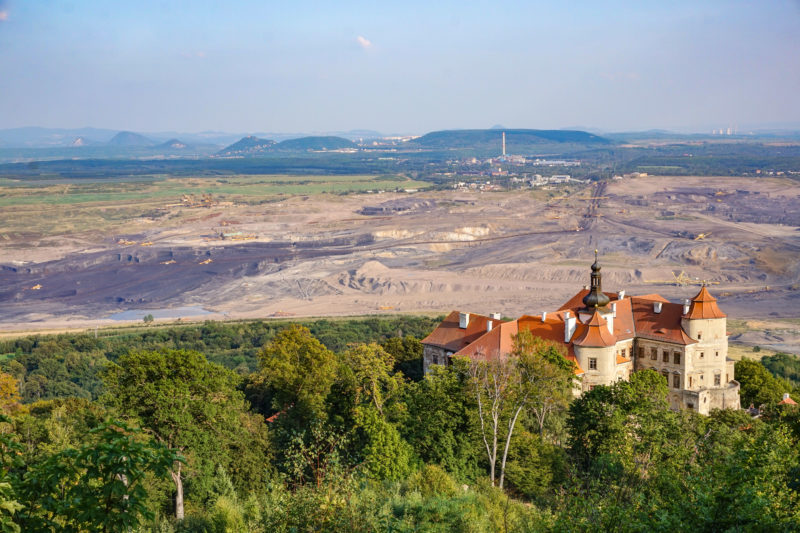
Chateau Jezeří: Beauty at the Edge of a Coal Quarry
In the north of the Czech Republic, there is a landscape where everything has disappeared: nature, villages, life. At the edge of this scenery stands a majestic chateau that has survived fires, wars, the communist regime and, most importantly, the coal mining all around it.
Chateau Jezeří
This chateau stands off the usual tourist trails. The area is known for its coal mining rather than its natural beauty. Yet at the edge of the coal quarry stands a remarkable chateau where famous composers such as Bach, Beethoven, and Mozart personally performed their compositions. Back then, they had a lovely view of a lake. Today, in the same place, there is one of the biggest quarries in the Czech Republic. Still, there is a plan for the lake to return one day.
Although the chateau had been ruined and stood empty, without any of its original furnishings, it opened its doors to the public in 1996. It was like urbex (urban exploration of abandoned places), somewhere time stopped centuries ago. You can still experience the same feeling today, because the renovation of the chateau is still in progress.


The History of Jezeří
The original Gothic castle burned down, and the Lobkowicz family rebuilt it in the Baroque style. At that time, it had a vast Baroque garden of about 500 hectares, and the stars of classical music, such as Bach, Mozart, and Beethoven, presented their latest compositions here. You can still see the original Baroque theater (waiting for its reconstruction) where these stars performed. It is worth mentioning that Beethoven’s famous Symphony No. 3, Eroica, had its world premiere at Jezeří.

World War II and Communism
The chateau’s unfortunate history continued during WW2, when the Lobkowicz family left the country because of their loyalty to Czechoslovakia. The SS took over the chateau, painted it green, and turned it into a prison camp for prominent French prisoners. Personalities such as the brother of French President Charles de Gaulle and Michel Clemenceau, son of Prime Minister Georges Clemenceau, were imprisoned here.
After the war, the Lobkowicz family got the chateau back for a short time, until the communist regime nationalized it in 1948. This started the longest period of decay. The Czechoslovak army used it as a base and destroyed everything that remained. In the 1980s, Jezeří was supposed to be demolished because of the coal mining around it, and it even disappeared from official maps. Thanks to the fall of communism and local activists, Jezeří has survived (in contrast to seven neighboring villages, which disappeared to make way for coal mining).

A Tour of the Coal Quarry
If you would like to visit the quarry itself, your best option is Offroadsafari (I have already explored the Central Bohemian Uplands with them). Jezeří isn’t in their regular program, so if you speak English, ask them about it when booking a private trip. If you speak Czech, you can also join one of their Czech trips to the ČSA quarry. Uhelné safari, run by the mining company itself, isn’t taking place in 2026.


I booked my visit with Uhelné safari, and we spent about four hours riding around the quarry. In a group of about 15 people, we explored the area with an experienced guide who took us right up to the mining machinery. We saw the mining in progress and learned about the history and future of mining in the region.
I found the information about the reclamation of the landscape and the future of this place fascinating. In 2019, the company was waiting for a government decision expected in 2021. If mining were to continue, several more villages would disappear and the quarry would expand. If coal mining were to stop, the quarry would be flooded (which would take about 16 years), and the original lake would be back in its place.


The edges of the quarry are already turning green as nature takes its land back. In these parts, you can even see animals such as foxes, wild boars, and mouflons. Still, I found the most fascinating edge to be the one by Chateau Jezeří, which overlooks this lunar landscape.


